
Getting Cobb County Court Records
Begin with the office that actually holds the file. State Court CourtConnect often opens a case detail page with a document link for county civil, misdemeanor, and traffic matters. Superior Court splits its online access. Web Case Management covers part of the civil and criminal files, and the Superior calendar library covers the rest. For small claims, dispossessory, garnishment, and warrant records, use the Magistrate Judicial Records Search. Probate offers its own no-login route. Juvenile access is tighter. A city ticket stays with the issuing municipal court unless it moves.
Online is only one channel, though. The Superior Clerk lets you review dockets on its website or at public terminals. Mail and in-person copy requests are both accepted. State Court records can be inspected through the State Clerk, but that office will not run an open-ended name search for you. A quick phone call helps you find the right counter. Georgia Courts E-Access lists local providers, and PACER covers federal records.
- Identify the court, case number, document type, and date range before asking for a record.
- Check the court’s online case or document route, then save the source and retrieval date.
- If the image is missing, ask the named Clerk whether the file is offsite, restricted, or available by copy request.
- Choose regular, certified, electronic, mail, or in-person delivery based on the use for the record.
- Use Georgia Open Records for a specific administrative or county-held record when the court clerk is not the right custodian.
Run a Cobb County case lookup first, so the case number is in hand before any copy or certification request goes out.
Cobb County Superior Copy Routes
The Superior Clerk's Request Copies page posts the current regular and certified mail amounts. They vary by record type. A mail request needs a written description, advance payment by cashier's check or money order, and a delivery address. Include a self-addressed stamped envelope too. Watch for a wrinkle: an older Services page lists a different per-page and certification structure and says personal checks are not accepted. Confirm the live amount with the Clerk before any payment goes in the mail.
Here is the current mail table. Civil documents run $3 regular and $10 certified, while criminal documents run $3 and $8. A criminal disposition package costs $5 regular and $14 certified. A final divorce decree is $3 and $10. Adding a settlement agreement brings it to $9 and $24. In-person and courier rates are posted too, and that gap with the older page is exactly why a live fee check matters.
The Superior Clerk Request Copies page carries the fee table.
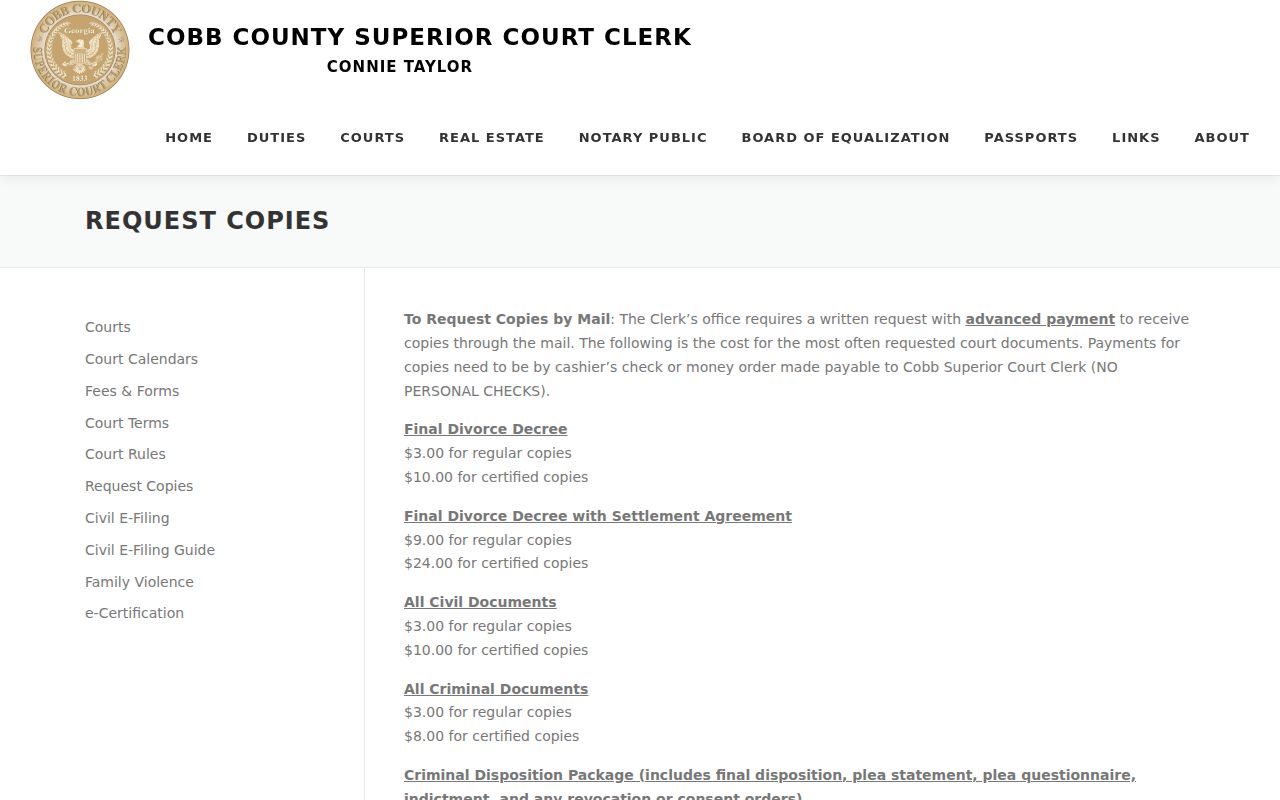
That fee schedule covers copy requests to this one clerk, not a promise that every court charges the same.
Court Record Types
Think of the docket as an index to a bigger Cobb file. Behind it sit pleadings, complaints, accusations, indictments, warrants, citations, affidavits, returns of service, answers, motions, notices, and orders. Judgments, sentencing documents, exhibits, transcripts, payment records, calendars, and certified copies sit there as well. A docket row can appear without an image. A filed document often holds detail no row reveals.
Record type follows the court. Superior Court holds felony cases, broad civil matters, domestic and equity cases, title disputes, orders, and docket files. State Court keeps civil, misdemeanor, and traffic cases plus its own calendars and filings. Magistrate holds small claims, dispossessory, garnishment, and warrant records. Probate and Juvenile run their own channels, and municipal clerks keep city records. Federal district, bankruptcy, and appellate files live outside Georgia county portals entirely.
Land records are a different universe. Deeds, liens, plats, instruments, parcel searches, and book-and-page records sit with the Superior Clerk's Real Estate Division, not in a civil case file. Name the request as a land record or a civil docket. That helps the Clerk route it right.
Cobb County eCertification
The Superior Clerk's eCertification page links to a secure Georgia service at ecert.gsccca.org. It delivers tamper-proof, self-validated certified court-record PDFs online or by email. One limit matters: this covers court records only, not real estate records. Some agencies refuse an electronic certificate. They want an in-person certified copy instead, so ask the receiving office first.
The public page does not list every order field or a fixed fee. Do not guess a price from the copy table. Use the live secure service for the order. Keep the case number, record type, and certification need clear. The Superior Clerk eCertification page shows the certified-PDF route.
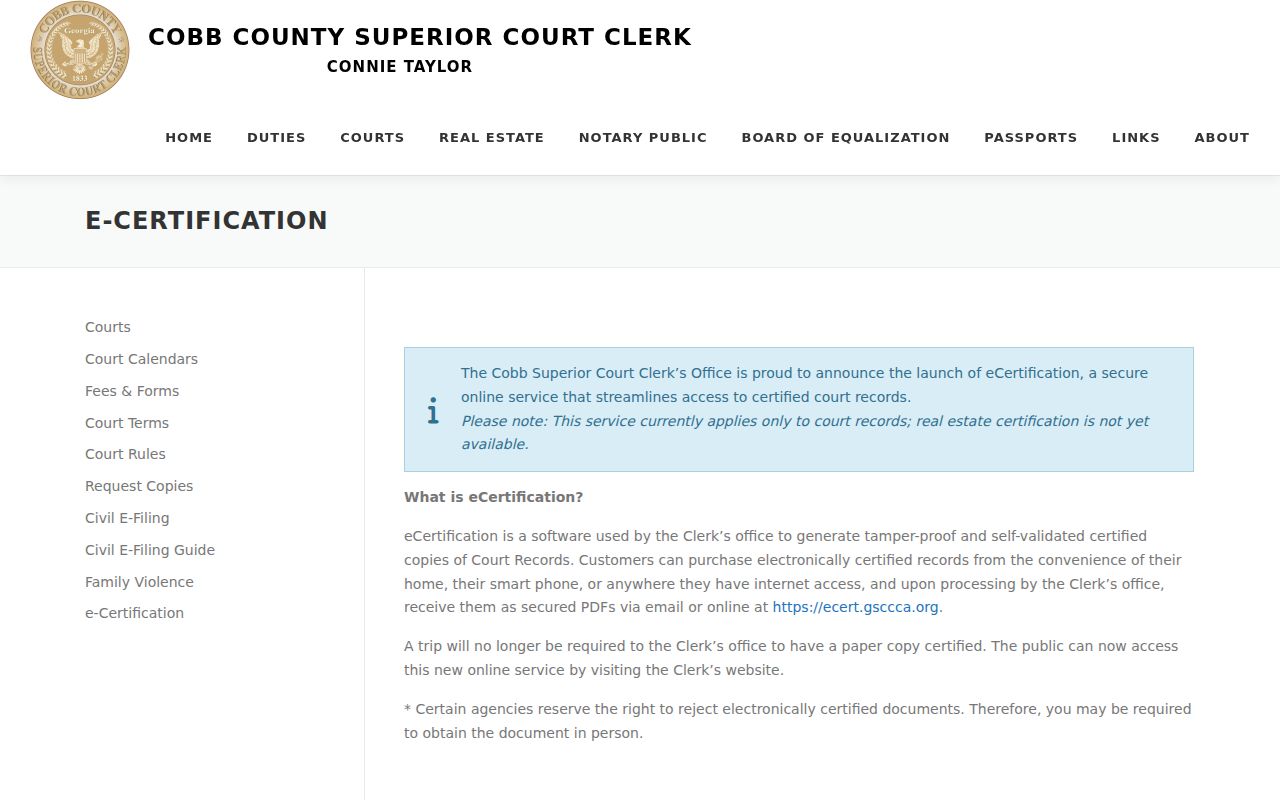
An electronic certificate is still just a court-record copy route. It will not certify a deed, and it does not lift access limits on a sealed filing.
Inside a Cobb County Court Record
A complete court record usually tells you more than a docket index can. The header at the top names the case, the court, the type of filing, and the date it began. Below that, the docket tracks each filing and event in order. The documents themselves carry the pleadings, orders, judgments, and exhibits. Financial lines show bonds, payments, costs, and outstanding balances when the system records them. Treat none of it as a final ruling until you read the court's own order.
Keep schedule, filing, party, and result fields separate in your notes. That habit stops a mix-up. A hearing date is not a verdict. A payment is not a dismissal. Precise notes also let you describe a record to a clerk when a document link fails to open.
| Case identity | Case number, style or description, court, filing date, case type, division, status, and related cases. |
|---|---|
| Events and settings | Date, time, room, location, judge, calendar type, event status, and setting description. |
| Docket entries | Entry description, filed or entered date and time, and related document link. |
| Parties and roles | Party sequence, association, role, attorney role, and other portal labels; redact private values. |
| Documents | Pleadings, orders, judgments, exhibits, sentencing papers, transcripts, payment records, or certified copies. |
| Disposition and money | Disposition, sentence, fine, payment, bond, balance, satisfaction, or case-complete status when displayed. |
A blank image can mean several things. The document may be restricted, the link stale, or the file stored offsite behind an account. Describe exactly what the public view shows, then ask the Clerk for the proper next step.
Cobb County Landmark Records
Landmark is the Superior Clerk's online search for land and real-estate records in Cobb County. You can search by name, document type, book and page, or parcel ID. Date range, instrument number, and legal description work too. Some results and images sit behind a search setting or an account. The page itself warns that electronic data are not guaranteed accurate or complete.
The Real Estate Office sits at 10 East Park Square, Building C, Marietta, GA 30090. The Real Estate Division answers at 770-528-1360. The official record lives there, not at the civil docket desk. Send any request for a deed, lien, plat, or instrument to that division.
The Cobb Landmark search screen keeps land records apart from case records:
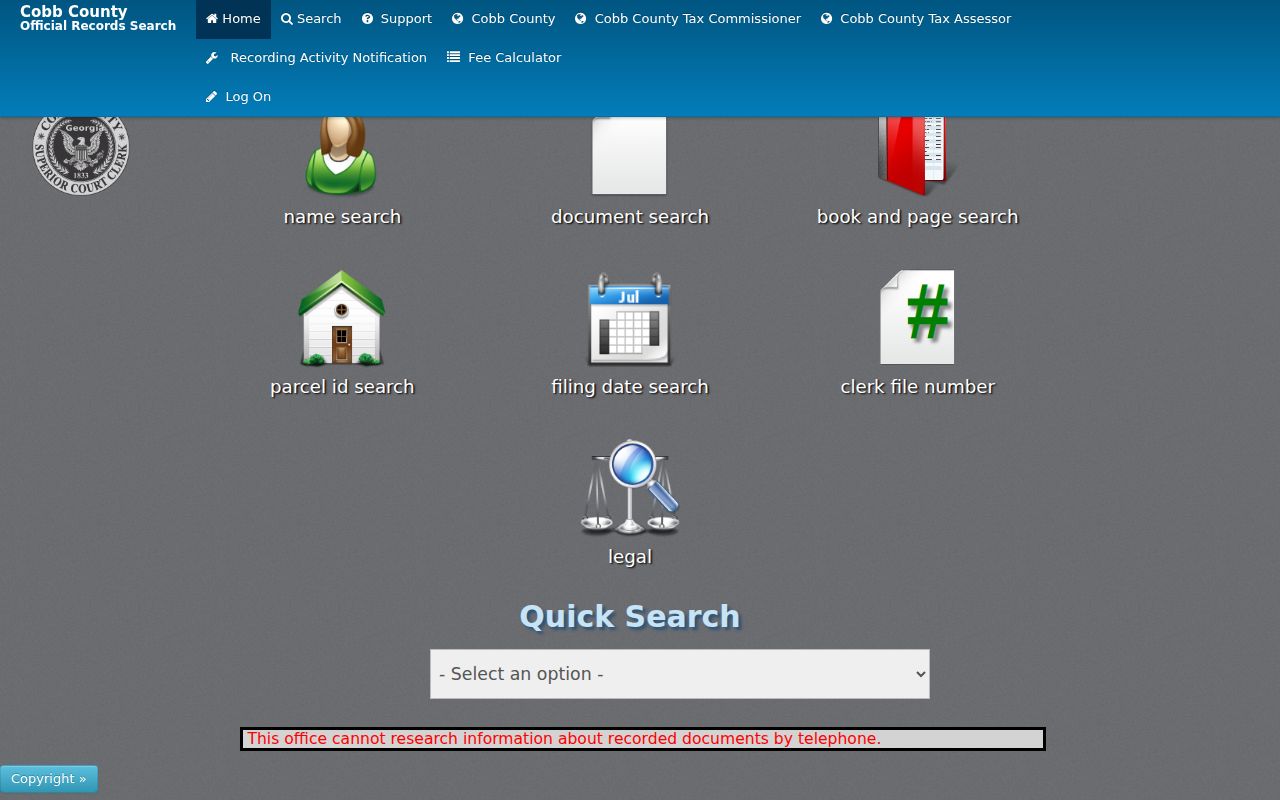
A Superior title or equity case can involve the same piece of property. Even so, the lawsuit and the recorded instrument are separate records. Each needs its own search and may need its own copy request.
Fees and Certified Copies
What a copy costs depends on the court. The record type, delivery, and whether you want it certified also matter. The current Superior mail schedule offers a useful local table. It is not a countywide price list, though. State Court's public pages stress inspection, online search, and Clerk routing. They post no matching fee table. Magistrate eFlex lists a filing charge. It gives no public-copy price. Always confirm the exact document and payment method before you send money.
| Superior record | Regular mail | Certified mail |
|---|---|---|
| Final divorce decree | $3 | $10 |
| Final divorce decree with settlement agreement | $9 | $24 |
| All civil documents | $3 | $10 |
| All criminal documents | $3 | $8 |
| Criminal disposition package | $5 | $14 |
An older Superior Services page prices "all other documents" at $0.50 per page. It adds $2 per certified document. The official pages disagree. Start with the current Request Copies page, and verify the amount at the counter or by phone.
For mail orders, pay in advance by cashier's check or money order. Include a self-addressed stamped envelope too. The older page rules out personal checks. A certified copy is simply an official one. It says nothing about the legal effect of the case.
Cobb County State Copies
State Court records are held at 12 East Park Square. The State Clerk points the public to online civil, criminal, and traffic searches and in-person inspection. It posts no universal copy-fee table like Superior's current schedule. Call State Court administration at 770-528-2622 or the State Clerk at 770-528-2660. Have a specific case number, entry, or document ready when you call.
Magistrate records sit with the Magistrate Clerk at 32 Waddell Street. The general number is 770-528-8900. Magistrate eFlex publishes filing charges and account rules. It lists no flat public-copy fee. Ask whether a regular or certified copy is available. Ask whether offsite retrieval adds a charge, and which payment methods the office takes.
Superior records route through 70 Haynes Street. The Clerk sits at 770-528-1300 and administration at 770-528-1800. Probate also sits at 32 Waddell Street and answers at 770-528-1900. Juvenile uses a restricted records route at 770-528-2220. One counter cannot copy another court's file. A countywide request should never assume it can.
Superior Clerk records
70 Haynes Street, Marietta, GA 30090
770-528-1300
State Court records
12 East Park Square, Marietta, GA 30090
770-528-2660
Sealed Records and Public Access
Uniform Superior Court Rule 21 makes public access the baseline. It also spells out how a court can restrict a filing. Rule 21.6 covers protected identifiers. Juvenile and Probate records follow their own rules and instructions. A public case may still hold a sealed exhibit. It may hold a protected address or a redacted identifier too. When an image is missing from a portal, that alone does not tell you why.
Here is a sample of what gets protected: full birth dates, full Social Security or taxpayer numbers, complete financial-account numbers, full residential addresses, minor children's full names, driver-license details, and similar private values. If access is denied, ask the Clerk what controls the request. It may be a sealing order, a protective order, a statutory exemption, or a copy procedure.
Public-record and court-access rules:
Uniform Superior Court Rule 21 supplies the Superior public-access baseline and sealing process.
Uniform Superior Court Rule 21.6 addresses protected identifiers and redaction.
O.C.G.A. § 50-18-70 et seq. sets Georgia’s public-record framework and exemptions.
O.C.G.A. § 9-11-7.1 guidance points civil filers to protected-identifier rules.
For procedure, copies, and access, ask a Clerk. A Clerk cannot advise you on the law or tell you whether a record proves a claim.
Cobb County Federal Dockets
Cobb's Open Records Center lets you create an account, track request history, and receive files. The Georgia Attorney General recommends putting your request in writing. Send it to the agency or court that holds the record. Describe the existing record clearly. This route fits an identifiable administrative record, a policy, a non-docket report, or a calendar archive. The county will not build a new case database. It will not compile a person's full court history.
The Cobb Open Records Center page shows the county request and file-delivery route:
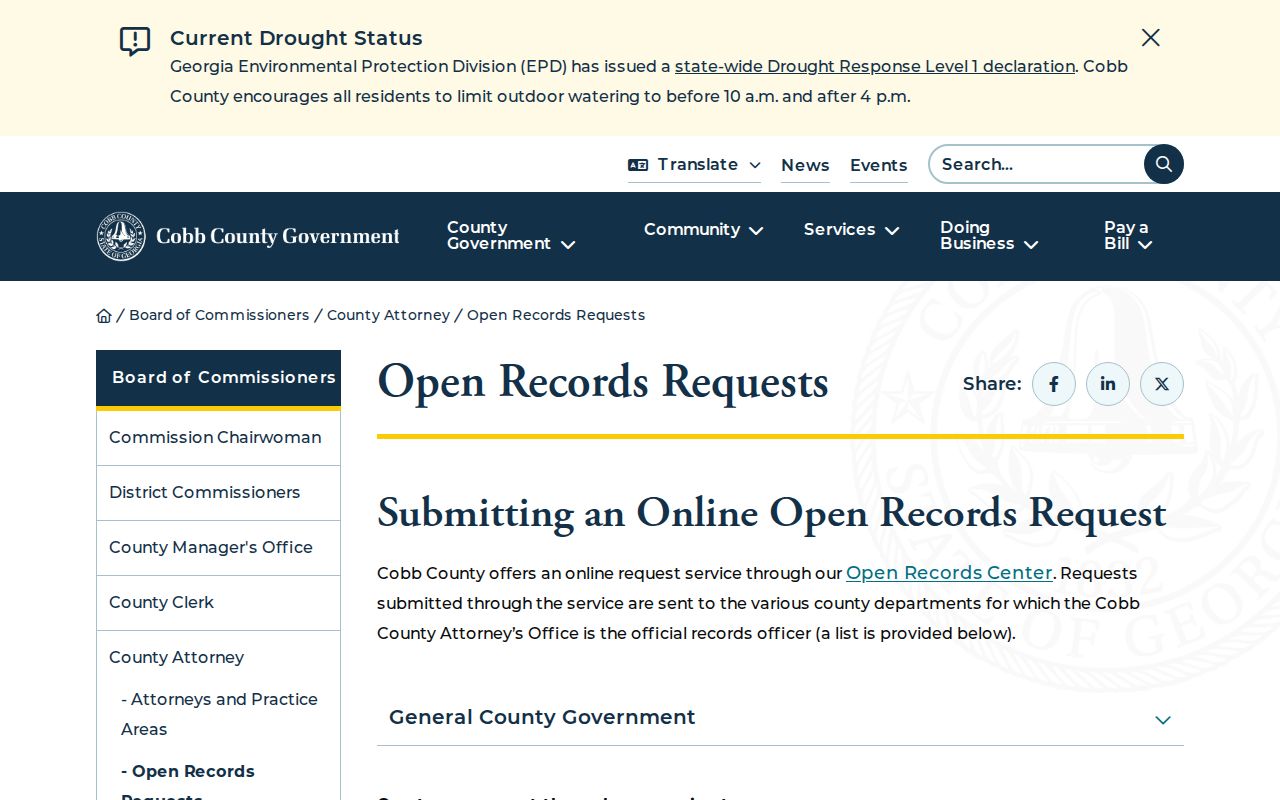
Need a filed document? A copy straight from the Clerk, or eCertification, usually beats an Open Records request. Federal cases go through a different system entirely. Cobb County sits in the Atlanta Division of the Northern District of Georgia, so federal district, bankruptcy, and Eleventh Circuit dockets all run on PACER and CM/ECF.
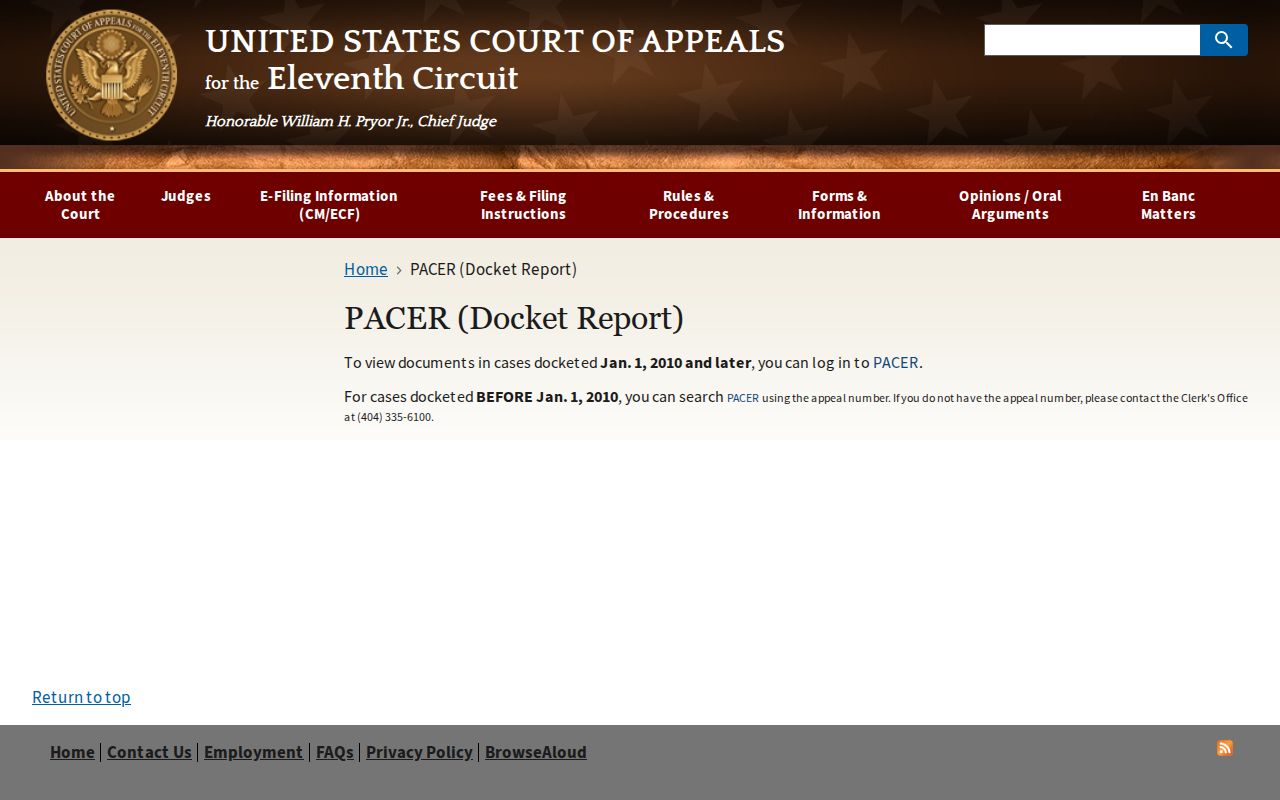
On the Eleventh Circuit side, timing matters. Appeals docketed January 1, 2010 and later are one track; older ones may require an appeal number or help from the Clerk. The Eleventh Circuit PACER route shows that federal access branch and how the court splits its docket search by filing date.
One caution applies here. PACER and CM/ECF can list a docket event while the document itself stays sealed or restricted, so the docket entry is not always the full file. CourtListener helps when a RECAP copy exists, yet PACER remains the federal record authority.