
Searching Cobb County Civil Dockets
Civil records in Cobb sit with five different keepers. These are Superior, State, Magistrate, the municipal courts, and the land-record system. Each level has its own tool. Superior cases may run through the Clerk’s Web Case Management shell. State Court civil cases appear in CourtConnect. Older finished files can sit in offsite storage, though. Small claims, garnishments, and dispossessory matters belong to the Magistrate Judicial Records Search. A deed or lien belongs in Landmark rather than any civil case search.
Try the case number first. Without one, pair a last or company name with a first name, a filing-date range, a case type, or the court. A name search can pull parties, attorneys, inactive records, or several cases at once. The Cobb County case lookup helps you compare the portals before a civil docket search begins.
- Identify the court from the case type, dollar ceiling, case-number pattern, filing office, or recorded-instrument description.
- Open the matching search route and choose the case mode or type required by that court’s form.
- Enter the case number when possible, or narrow a name search with a date range, party role, and case type.
- Read the case header, parties, service, pleadings, motions, hearings, judgment or disposition, payment, and document links as separate fields.
- Ask the named Clerk for a public-terminal review, copy, certified record, or offsite retrieval when the online index is incomplete.
Cobb County Civil Court Split
There is no single keeper of the civil docket in Cobb County. Superior Court holds general civil jurisdiction, from equity and title work to domestic relations and broad civil matters. State Court handles county-level civil actions, garnishments, evictions or dispossessory matters, personal-property foreclosures, costs, and the Division I calendars. Magistrate Court takes small claims up to $15,000. It also takes garnishments, dispossessory cases, bad checks, abandoned vehicles, and related records.
Municipal courts keep city ordinance, code-enforcement, environmental, and citation records. An event that happened in Cobb does not turn those files into State Court records. Recorded deeds, liens, plats, and other instruments sit with the Superior Clerk’s Real Estate Division and Landmark. The same elected Superior Clerk may hold the records. But the type of search still differs.
| Record path | What it covers | Where to start |
|---|---|---|
| Superior civil | General civil, domestic, equity, title, and broader Superior matters. | Superior Clerk Web Case Management, public terminal, calendar, or Clerk counter. |
| State civil | County civil actions, garnishments, dispossessory work, costs, and State Court calendars. | CourtConnect or State Court civil-division routing. |
| Magistrate civil | Small claims up to $15,000, garnishments, dispossessory, bad checks, and execution records. | Magistrate Judicial Records Search or 32 Waddell Street counter. |
| Land records | Deeds, liens, plats, instruments, parcel searches, and book/page records. | Superior Clerk Landmark and the Real Estate Office at 10 East Park Square. |
For current clerk services and e-filing links, begin with the Cobb Superior Clerk courts page. It points to each service, though the four record paths stay separate. No one search covers them all.
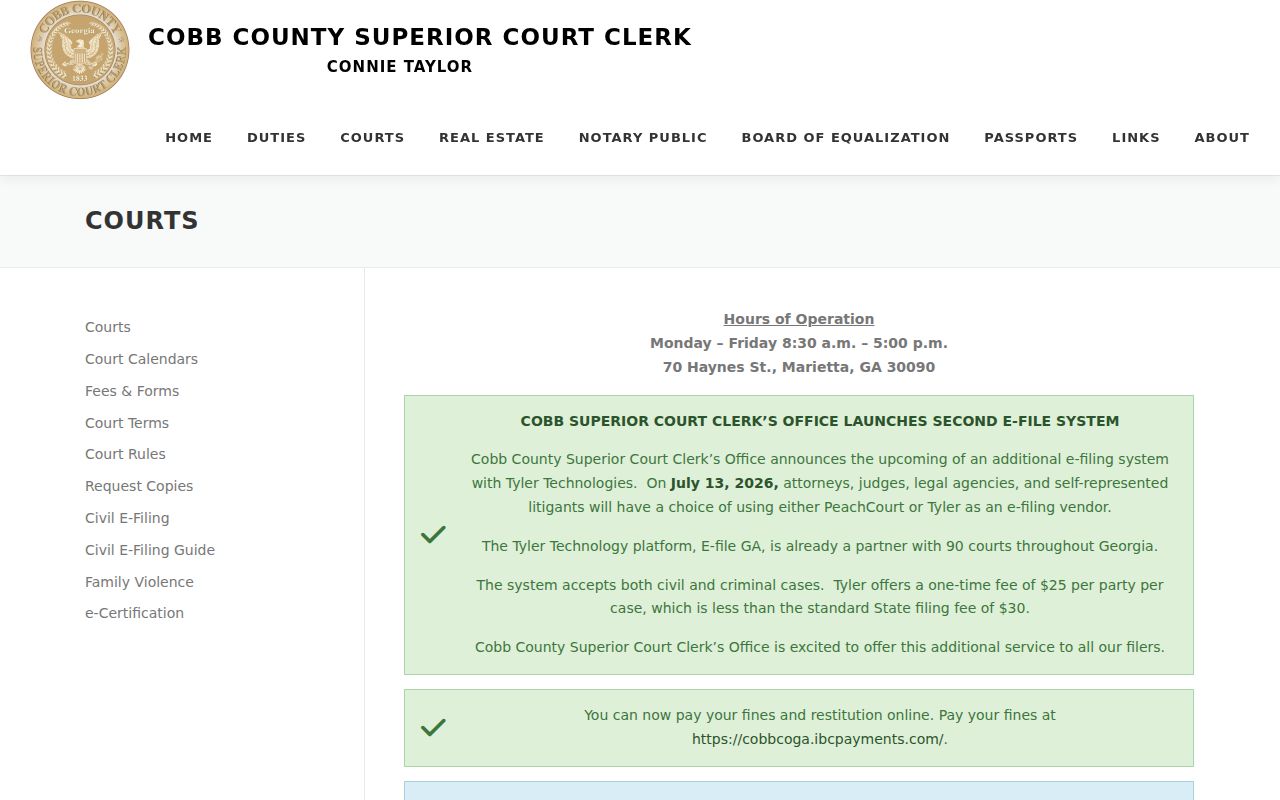
The Clerk’s service screen shows the same lesson from another angle. Name the civil record type first, then ask for a search or copy.
Inside a Cobb County Civil Docket
A civil docket is a timeline: filings, service, responses, motions, settings, and results in order. The header can carry the action number, cause, filing date, case type, party roles, attorney roles, status, and costs. Below that come service entries, answers, discovery, hearings, mediation or settlement notes, the judgment type, payment or satisfaction, transfer, appeal, and links to documents.
Magistrate files show the sequence plainly. One small claim can move from complaint to sheriff service fee, personal or corporate service, hearing notice, contested hearing, answer, interrogatories, judgment by default, payment, request for FiFa, and form-created FiFa. Every entry means something distinct. A complaint is not a judgment. A service charge proves nothing about the merits of the claim.
| Case header | Action number, cause or description, filing date, case type, status, related cases, costs, and balance when displayed. |
|---|---|
| Parties and counsel | Party roles, attorney roles, sequence, association, and names; redact private values from public notes. |
| Service | Service date and type, sheriff fee, personal or corporate service, and related returns. |
| Responses and discovery | Answer, amendment-answer, interrogatories, motions, notices, and other pleading or discovery entries. |
| Settings | Hearing date, time, courtroom, location, judge, calendar type, and event status. |
| Result layer | Judgment, dismissal, settlement, payment, satisfaction, transfer, appeal, and document links, each read in context. |
Read civil status terms with care. “Judgment by default,” “dismissed,” “settled,” “civil paid,” “satisfied,” “transferred,” and “closed” do not mean the same thing. Quote or describe the docket entry with its date, then check it against the order or a certified copy before calling any outcome final.
Cobb County State Civil Files
The State Court civil division files and processes lawsuits, garnishments, evictions or dispossessory matters, personal-property foreclosures, and costs. It also keeps the calendars for State Court Division I judges. CourtConnect civil coverage starts March 17, 1997. But a coverage date is no promise that every document is online. Older completed civil cases and garnishments may be stored offsite.
The State civil page lists a $7 advance fee for some older records. It also states that the division does not run record searches. Give the clerk a case number, a party, a filing date, and the exact record you want. If the case does not appear online, ask about offsite retrieval or an in-person look. Do not read the absence as proof the case was never filed.
Records may be inspected through the Clerk during normal business hours. The State Court Clerk sits at 12 East Park Square, Marietta, GA 30090. State Court administration is listed at 770-528-2622, and the State Clerk at 770-528-2660. The civil pages also separate filing from records access. So requesting a copy does not file a new pleading.
The Cobb State Court overview routes to CourtConnect and the civil division. When an older-record fee or storage question affects a deadline, rely on the live page for current instructions.
Civil Case Types on the Docket
Civil work in Cobb County splits across several courts. Superior Court takes equity, title, and family matters, plus broad civil claims. State Court handles county civil work within its own jurisdiction. Magistrate dockets carry the smaller claims. Possession actions sit there too. Municipal cases may look civil, but a city record is still an ordinance or citation case.
Magistrate civil cases top out at $15,000. That number marks jurisdiction, not a docket row. Expect entries for service, hearings, answers, defaults, payments, executions, or transfers. A transfer to Superior continues under a new case number, so follow it there.
Deeds, liens, plats, and book-and-page entries deserve a separate label. None of those is a civil case docket. The Superior Clerk runs both systems, so mix-ups happen. Searching the wrong one can bury a live lawsuit or return a false "no record."
Cobb County Magistrate Civil Search
Cobb Magistrate keeps its own judicial records search, apart from State Court CourtConnect. You must pick Civil or Criminal mode. From there the form offers a case type or All, phonetic search, last or company name, first and middle name, a filing-date range, and case number. Results stop at the first 5,000. A case number or narrow case type is safer.
The civil division counter sits at 32 Waddell Street, Marietta. Call 770-528-8900 for general questions. The portal warns that displayed data may be incomplete or not current. Party addresses can be historical or current. Treat an online docket view as a lead until the Clerk confirms the file.
The Magistrate Judicial Records Search page explains the portal and its limits. It lays out the local search path:
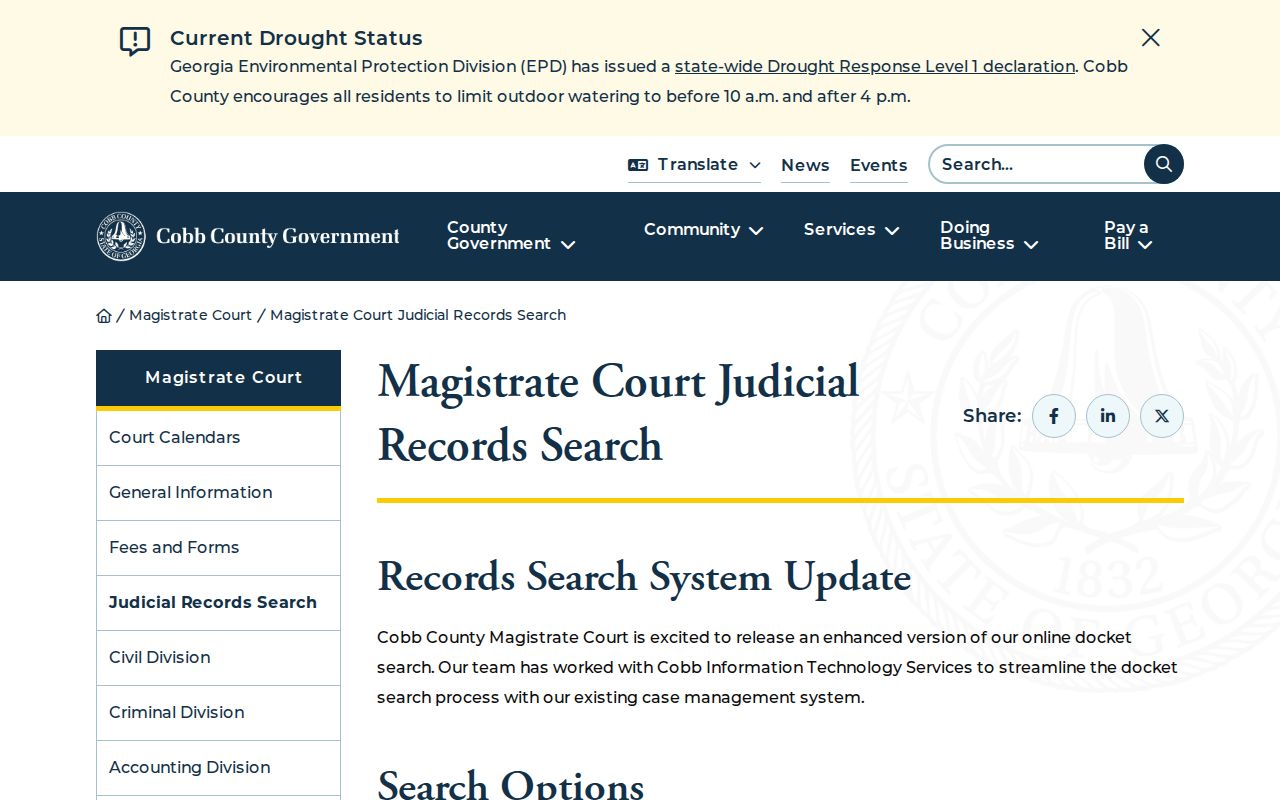
The overview keeps Magistrate civil records separate from the county's other court systems. The live form adds its field controls:
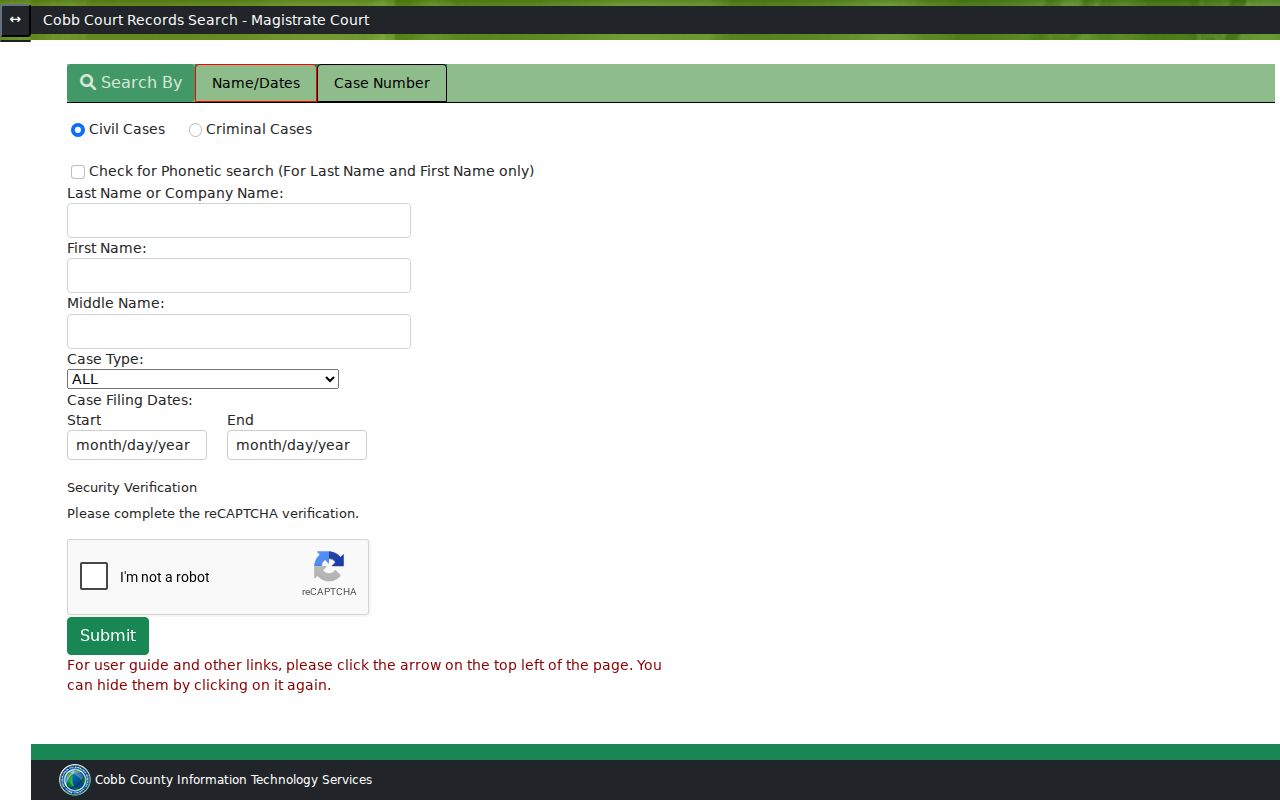
Magistrate eFlex is a filing channel. It does not replace the public docket search. Its agreement restricts authorized filing to attorneys, approved pro se filers, and agents, and the portal lists a $60.50 Magistrate civil filing charge. A fee is not a judgment amount, and it says nothing about what happened in the case.
Civil Docket Settings and Hearings
A civil setting is an event, not an outcome. Calendar fields can show date, time, courtroom, location, judge, cause, party role, attorney role, status, or calendar type. A motion setting may end in an order. A contested hearing may lead to judgment later. A non-jury calendar can list a case that gets continued or settled.
State Court posts calendars for its civil divisions. Superior publishes PDF calendars for non-jury, motion, TPO, URESA, uncontested, and other settings. A printed calendar is easier to scan than the interactive case shell. It is still a snapshot. Check it against Case Events, docket entries, and the entered order.
For anything date-sensitive, confirm the current setting with the Clerk. Superior administration is at 770-528-1800. The Superior Clerk is at 770-528-1300. State Court keeps its own administration and Clerk contacts. The courthouse cluster packs 70 Haynes Street, 12 East Park Square, and 32 Waddell Street together, so read the address on the case record.
Cobb County Superior Civil E-Filing
Superior civil e-filing works two ways. Attorneys get a filing workflow. The public gets a review workflow. The Clerk's civil guide lists two local case-number forms, 17102331 and 17-1-2331. Dockets can be reviewed on the Clerk website or at public terminals. Public review needs no filing account or special authority.
The Clerk's page says PeachCourt runs 24 hours a day, takes cards or bank draft, and charges $3 for eService. A July 2026 update added Tyler Technologies E-file GA for Cobb Superior civil and criminal filings starting July 13, 2026. The vendor change brings a one-time $25 per party per case charge, separate from the state filing fee. Because that change is recent, confirm the live page before trusting any cost figure.
The guide also draws boundaries. Leave the top-right filed-stamp area blank. File the complaint first. Include a disclosure statement so the judge gets assigned, and attach exhibits to the supporting document. Motions require notice to the judge. Proposed orders, scheduling or cancellation documents, subpoenas, transcripts, and depositions carry separate instructions or are excluded. Sealed cases and documents need their own handling.
The Superior civil e-filing guide covers the public terminals, case-number forms, sealing, and filing exclusions:
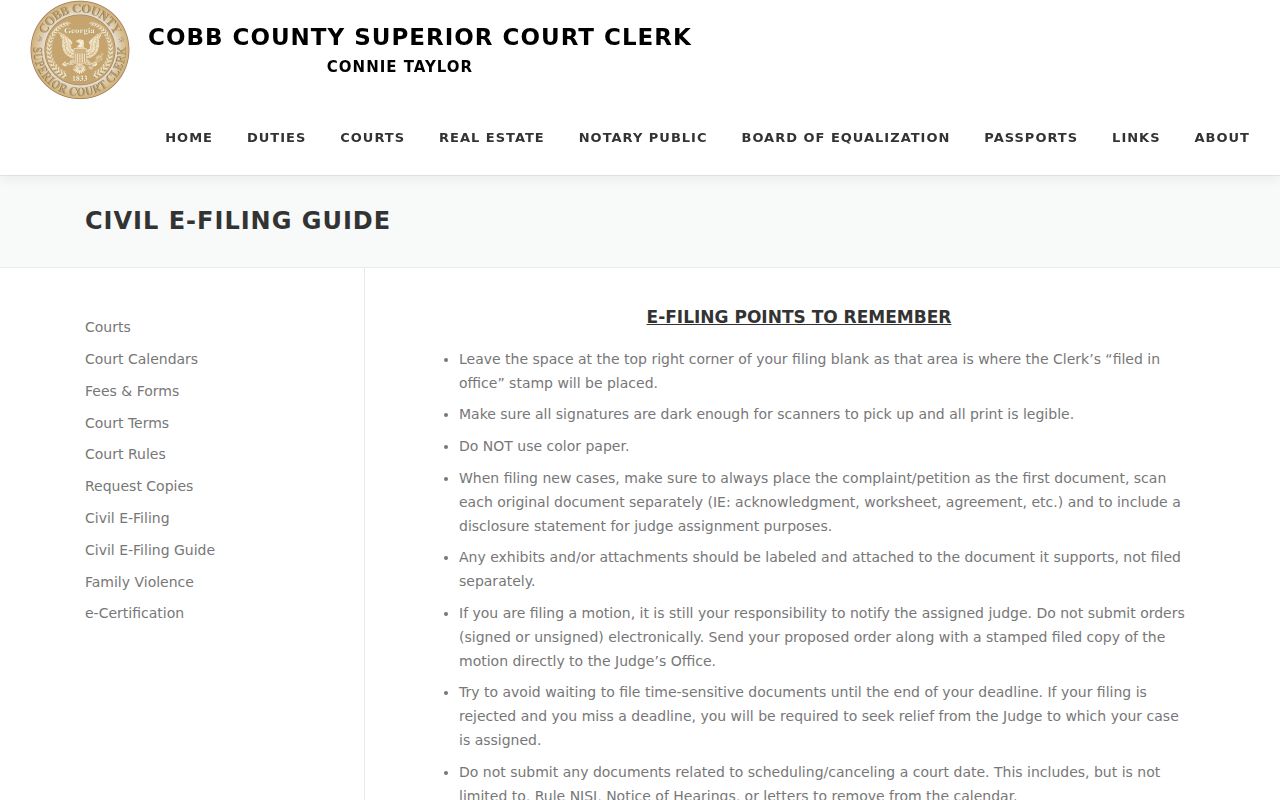
The guide draws a clean line between reading a docket and filing into a case. That line matters before you file.
Civil Docket Access Rules
Open to the public does not mean every field shows. Uniform Superior Court Rule 21 sets the baseline. It also governs how a court restricts access. Rule 21.6 covers protected identifiers. Cobb's civil guidance adds O.C.G.A. § 9-11-7.1, which controls redaction and protected-identifier rules in civil filings.
Some values should never sit in a public filing. That includes full birth dates, Social Security or taxpayer numbers, complete financial-account numbers, full residential addresses, minor children's full names, driver-license information, and any other private data a docket field does not need. Redact what the record can spare. Sealing works file by file, so one sealed exhibit or filing does not hide the whole case. A missing image can also stem from a stale link, a document that requires another request, or a portal limit.
Rules for a Cobb civil record request:
Uniform Superior Court Rule 21 treats public access as the baseline and uses a court process for sealing or restricting records.
Uniform Superior Court Rule 21.6 addresses protected identifiers and redaction.
O.C.G.A. § 9-11-7.1 guidance links civil filing redaction requirements to the Cobb civil division.
Georgia Open Records request guidance directs a request to the custodian and calls for a statutory basis if material is withheld.
Try the court's direct access channel first. A Georgia Open Records request suits an identifiable administrative record, policy, or calendar archive. It should not ask the county to create a new case compilation. For a filed pleading, docket entry, order, or certified copy, the named Clerk remains the right route.
Cobb County Land Records
The Superior Clerk's Real Estate Division keeps deeds, liens, plats, and other recorded instruments. Landmark offers several search modes. Name, document, book and page, parcel ID, record-date range, instrument number, and legal description each get their own path. Account or image controls may appear once a search runs. Those fields index land records, not a civil lawsuit.
The Real Estate Office sits at 10 East Park Square, Building C, Marietta, GA 30090. Its Real Estate Division can be reached at 770-528-1360. Landmark itself warns that electronic data are not guaranteed accurate or complete, and it points users to the office for the official record. So call it a land-record request when you write.
Civil claims about title, property, or equity can still show up in Superior civil records. Two searches may involve the same property. They are not the same record. Start with the Superior case number for the lawsuit. Then search Landmark for the recorded instrument when the question is a deed, lien, plat, or book-and-page entry.
Label each result note. Use "Superior civil docket" for the case file and "Landmark land-record search" for the recorded instrument. Reserve "official Clerk copy" for the version the Clerk itself supplies.